Why do bees die when they sting?
Because a honeybee's barbed stinger usually catches in skin and tears out of the bee's body, and that wound kills it. Only worker honeybees die this way: a queen can sting more than once, and males have no stinger. The bee doesn't die on the spot: workers have been recorded surviving 18 to 114 hours.
What the reel shows
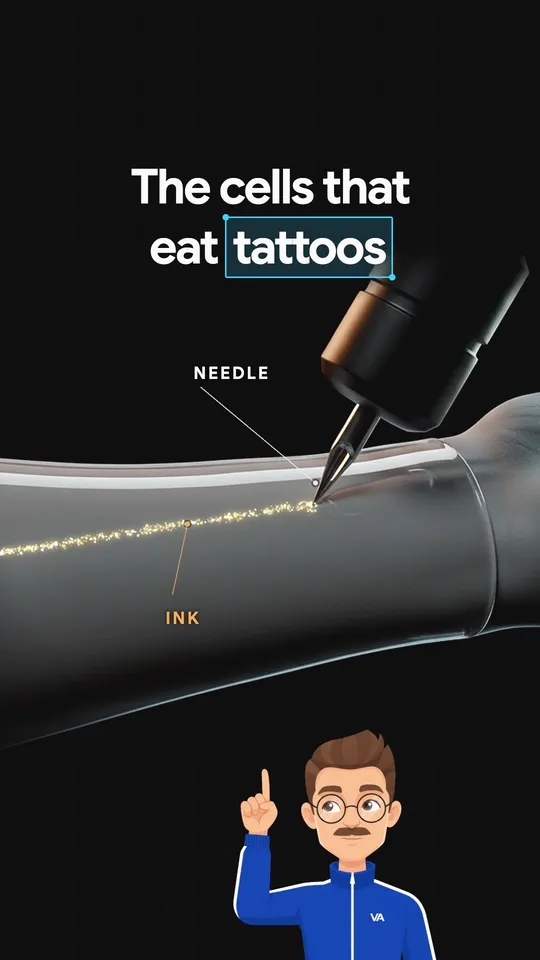
The reel opens on a worker honeybee stinging a forearm. A cutaway through the skin shows the stinger's rows of backward barbs, set beside a fish hook to show how they catch. The bee keeps pulling until the stinger tears out of its body, and it flies off. The stinger stays behind in the skin, still pumping on its own.
Transcript
When a honeybee stings you, it usually can't pull its stinger back out. The stinger has rows of tiny hooks called barbs, and every barb points backward. So the stinger works like a fish hook. It slides in, but when the bee pulls back, the barbs catch in your skin. The bee keeps pulling, until the stinger rips out of the bee instead, and takes part of the bee's body with it. The bee flies off without its stinger, and that injury kills the bee. And the stinger stays hooked in your skin, still pumping venom into you, on its own.
The facts, with sources (7)
- The barbs point backward. Each of the honeybee stinger's two lancets has a row of barbs that point away from the tip. UC Riverside's entomologists describe "two lancets with recurved barbs". Bissessarsingh & Starr 2021, Insects · UC Riverside Entomology
- Skin holds the barbs. In a lab test on pig skin, pulling a honeybee sting out took on average 3.28 times the force needed to push it in. Mammal flesh is elastic, which makes it "almost impossible" for the bee to pull the stinger back out. Zhao et al. 2015, Biology Open · Pucca et al. 2019, Frontiers in Immunology
- The stinger tears out of the bee. The sting detaches and "takes with it the entire distal segment of the bee's abdomen", including a nerve ganglion, muscles and the venom sac. UC Riverside Entomology · PBS NewsHour, 2014
- The wound kills the bee, but not at once. Losing the sting is "followed by the death of the mutilated bee". A 2019 review reports workers staying alive for 18 to 114 hours afterwards, a figure that traces back to a single 1951 study. Nouvian et al. 2016, Journal of Experimental Biology · Pucca et al. 2019
- The stinger keeps pumping venom on its own. A 2026 study describes the detached stinger as "a unique double-piston micro-pump". The venom sac's wall has no muscle: a valve system on the sliding lancets does the pumping. Ramirez-Esquivel et al. 2026, PNAS · UC Riverside Entomology
- Only worker honeybees die from it. "Of the three castes in the colony, only the female worker bee dies when it stings. The queen can sting multiple times. The drone (male) has no stinger." Wikipedia, citing UC Berkeley's Urban Bee Gardens site, says honeybees are the only bees to die after stinging. UC ANR Bug Squad, 2014 · Bee sting (Wikipedia)
- A shallow sting can come back out. UC Davis entomologist Eric Mussen says how well the sting stays stuck "depends upon how deeply it was pushed in". When the point barely pierces the skin, "the sting can be pulled out if the bee begins to leave". Most stings go deep. A honeybee can also pull its stinger back out after stinging another insect. UC ANR Bug Squad, 2014 · Bissessarsingh & Starr 2021