Why does pineapple burn your tongue?
Fresh pineapple is full of bromelain, an enzyme that breaks down protein, and it breaks down some of the mucus that protects your tongue and cheeks. With that layer thinned, the fruit's acid reaches the lining underneath and stings. Canned pineapple is still acidic but doesn't sting, because the heat from canning destroys the enzyme.
What the reel shows
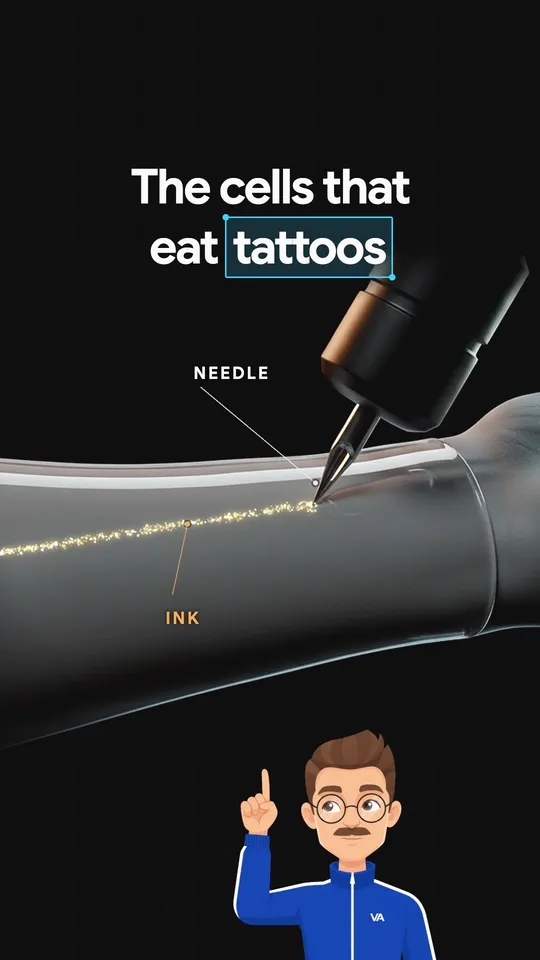
The reel opens on a bite of fresh pineapple. Inside a drop of juice, the enzyme is drawn as tiny scissors cutting a protein strand, then shaken onto a raw steak as meat tenderizer. A cross-section of the tongue shows the mucus thinning and the acid reaching the lining. It ends on canned pineapple: pH strips show both are acidic, and a thermometer in the can shows the heat that destroys the enzyme.
Transcript
A few bites into fresh pineapple, your tongue starts to sting and feel raw. Pineapple is full of an enzyme that breaks down protein. It's the same enzyme that's sold to soften raw steak. In your mouth, it breaks down some of the mucus that protects your tongue and cheeks. So the fruit's acid reaches the lining underneath, and it stings. But canned pineapple doesn't sting. It's still acidic, but the heat from canning destroys the enzyme.
The facts, with sources
- Pineapple carries a protein-digesting enzyme. Bromelain is a group of protein-digesting enzymes found in the stem and fruit of the pineapple. NIH, National Center for Complementary and Integrative Health
- It's the same enzyme sold to tenderize meat. US meat rules approve bromelain (listed as "bromelin") to soften the tissue of raw meat cuts. 9 CFR 424.21 (eCFR)
- It breaks down some of your mouth's mucus. McGill's Office for Science and Society says bromelain can break down some of the mucus in saliva that protects the lining of the mouth. In a lab study, bromelain broke up the structure of mucin, the glycoprotein that makes mucus (tested on intestinal mucin). McGill Office for Science and Society · Pereira de Sousa et al. 2015, European Journal of Pharmaceutics and Biopharmaceutics
- Then the acid stings. Without that protection, the fruit's acidity causes the prickle, according to McGill and Rutgers food scientist Karen Schaich. It's the leading explanation rather than a settled one: another Rutgers food engineer describes the sting as likely the acid and the enzyme working together. McGill Office for Science and Society · Karen Schaich in Inverse · Live Science
- Canned pineapple is still acidic. FDA figures put fresh pineapple at pH 3.20 to 4.00 and canned at 3.35 to 4.10, yet canned pineapple doesn't sting. FDA, Approximate pH of Foods (archived copy, PDF) · Inverse
- Canning heat destroys the enzyme. Canned pineapple is heat-processed to prevent spoilage, and that heat destroys the enzyme. In a lab test, fruit bromelain lost almost all its activity after 8 minutes at 80 °C. McGill Office for Science and Society · 21 CFR 145.180 (eCFR) · Jutamongkon & Charoenrein 2010, Agriculture and Natural Resources
- The same enzyme stops gelatin from setting. Fresh pineapple keeps gelatin from setting while canned pineapple doesn't, and grilling or searing the fruit switches the enzyme off too. McGill Office for Science and Society · Inverse