How to write an explainer reel script people can follow on one listen
An explainer reel is heard once, at speaking speed, by someone who can't scroll back. My first AI-written reels for @valueanimate read well on paper and lost me on the first listen, so I rebuilt the script method around one test. Here is that method, the checks I run, one real script taken apart line by line, and a template you can copy.
The one test
Someone who hears it once, at speaking speed, can picture every sentence and retell the story correctly.
A reader glances back when a line doesn't land; a listener can't. In a meta-analysis of 46 studies, reading beat listening most on questions that need an inference (Clinton-Lisell 2022). A listener gets lost exactly where a script leaves a link to work out.
My first three reels of the revival underperformed. The facts were right; the scripts were written for a reader.
One idea per reel
Before writing a line, I reduce the reel to one sentence. For an explainer: When [situation], [visible event] happens, because [one cause]. For a story: [Person] did X, so Y happened. Every voiceover sentence must be a step of it. Side facts go to the caption or become their own reel.
My first batch carried a median of two ideas per script. Nine same-topic scripts by Zack D. Films, the channel I benchmark against, had one each. My knuckle reel explained the pop, then switched to a man's fifty-year experiment with "Then there's the arthritis." Heard once, that "then" sounds like arthritis comes next.
Facts first: the claim ledger
Every script starts with a claim ledger: 8 to 15 facts, each with a source URL, a status (verified, commonly cited or uncertain) and a use:
- speakable: solid enough to say flatly in the voiceover;
- screen-only: it needs a range, a hedge or a citation, so it goes on screen or in the caption.
If a fact needs three qualifiers to be true, it's the wrong fact for a reel. A flipped misconception needs a source showing people believe it. If the payoff can't be verified, stop; don't write around it. Stories raise the stakes: the more absorbed people are, the fewer critical thoughts they have (van Laer et al. 2014).
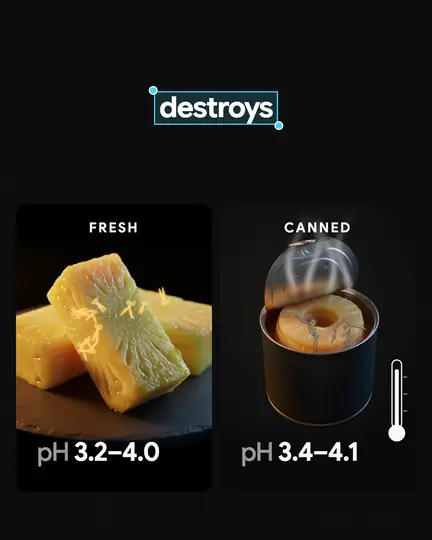
In the pineapple reel, the pH ranges sit on screen. The voice only says "It's still acidic."
Line 1 is a picture
Line 1 puts a body (you, or one person) in a place or a moment, with something wrong by about the ninth word, drawable at frame 0. A claim, a belief or a property is never its main clause.
- A claim: "Some smoke alarms carry a speck of metal made from nuclear reactor plutonium." (my smoke alarm reel)
- A picture: "A few bites into fresh pineapple, your tongue starts to sting and feel raw."
Of the 70 most-viewed Zack D. Films scripts in my corpus, 61 open on a you-situation, an action under way, or "When a [thing] does X". And "you" works when it acts: action statements told with "you" are remembered better (Ditman et al. 2010).
Clarity beats freshness. My old hook filter rejected "When you eat fresh pineapple, it starts eating you back" as too typical, though it was the clearest line on the list. And sentence 2 escalates or flips; it never gives background.
Tell it in order, one moment per sentence
This is where my first scripts broke.
- One moment per sentence, and time only moves forward. A jump in time or place gets its own sentence, marker first ("Fifty years later," "Inside your knuckle,"). No flashbacks.
- Call people what they are at that moment. A teenager is a teenager when he's warned.
- Introduce before you use, and keep one name per thing. Bubble, bubble, bubble; never bubble, cavity, pocket.
- A chain, not a list. Each sentence picks up where the last one ended, with a spoken link: so, but, then, which means.
- One new thing per sentence, with a drawable subject doing a physical verb. A long sentence is fine when it follows one event. Numbers are rare.
The line that taught me this, from my knuckle reel:
One doctor's mom warned him, so for over 50 years he cracked his left hand twice a day and kept the right one to compare.
That's three roles, two time frames and four facts. In the first-listen test (below), four of ten retells got who was who wrong, along the lines of "his mom, who was apparently a doctor". That's exactly what I had heard. He was a teenager when she warned him. Told for the ear:
A teenage boy got that warning from his mom. So he started a test. Twice a day, he cracked the knuckles on his left hand. He left the right hand alone, to compare. He kept it up for over fifty years.
The first reading of a sentence sticks, even when later words contradict it (Christianson et al. 2001). Events told in order are remembered better (Clark & Clark 1968), and time jumps slow readers down (Zwaan 1996). The benchmark's top 70 scripts open 22% of their sentences with a time word; my first batch, 9%.
The ending and the CTA
The ending pays off something the viewer saw: the final state of the opening scene, a callback to it, or the answer to line 1's question. It needs no outside knowledge. If the twist is a detail, one plain line says what it means. Then the story stops: no summary, no moral, no poll. My knuckle reel ended "…so he looked up and yelled, 'You were wrong, Mom.'" "Looked up" only works if you know his mother had died, which the script never said.
Why the follow ask stays out of the story
The CTA comes after the payoff, in its own section of the script. A share line is one sentence of 14 words or fewer that names a specific person: "Send this to the friend who eats a whole pineapple anyway." "Send this to a friend" fails. The follow line is fixed: "And follow for more." after a share line, "Follow for more." on its own.
An ask in the middle breaks the chain and signals the end early. And Instagram said in June 2024 that it may not recommend reels that explicitly ask for shares, comments or tags; its creator FAQ says engagement bait limits distribution. So my CTA is a switch: every reel renders with and without it, and my first ten reels test share, follow, both and none. The results aren't in yet.
Length follows the story
There is no word budget. A reel runs from 20 seconds to 2:50, and the story decides: 20–30 s for one mechanism with one surprise, 30–45 s for a myth flip plus its mechanism, 45–75 s for a cause chain or a true story with one person, and up to two minutes for four or more reveals.
I plan at 2.75 words per second, and from the next batch on, the voice will run at its natural pace. When clarity needs words, I cut an idea, never the time markers, nouns or links. Past 45 seconds, the story needs a turn every 13–25 seconds.
In my corpus, Zack D. Films' 35–50 s Shorts beat his 20–35 s ones in every year from 2022 to 2026. Instagram recommends reels of up to three minutes to non-followers (Instagram), and Meta's ranking compares how much of a reel you watch with reels of the same length (Meta).
Speed matters less than I thought. My first batch ran about 20% faster than the benchmark, but speech comprehension holds up to about 275 words a minute (Foulke & Sticht 1969). What each sentence carries matters more.
How to check a script
Read it aloud, then run four gates in order: the linter, the first-listen test, a separate critic, my own read.
Read it aloud, then play it to someone fresh
Reading aloud catches stumbles: a dash the voice can't say, a word like "wound" it might misread. It won't catch confusion, because you know the facts, and better-informed people can't set that aside when they predict what others understand (Camerer, Loewenstein & Weber 1989). Play it once to someone who hasn't seen the script and ask for the story in one sentence.
The linter
lint_script.py is code, not judgment, because models are poor at spotting AI writing tells: in one study, the best managed 0.46 precision (Chakrabarty, Laban & Wu 2025). It fails announcing openers ("Did you know", "Let's dive"), hype words, connectors like "however", punctuation a voice can't speak and phrases copied from competitors. It warns on ear problems: flashbacks, "-ing" openers, a bare "That" pointing at a whole event, two numbers in a sentence. At calibration, its word rules failed 23% of the benchmark's top 70 scripts and 52% of his flops.
The first-listen test
listen_test.py is the gate I added after my first batch:
- Before drafting, the writer seals a key: the gist, the chain of 4 to 7 events, and who was what at each moment. Nobody edits it to pass.
- Ten simulated listeners (a 14-year-old, a tired adult at midnight, an intermediate English speaker, a newcomer to the topic and a sceptic, twice each) hear the voiceover one sentence at a time, with only a short memory note.
- After each sentence, every listener flags it CLEAR, LOST, WHO, WHEN or WORD and says what it pictures.
- Each retells the story from memory, and a judge that never sees the script scores the retells against the key.
The listeners run on Gemini, a different model family from the writer. A pass needs at least 85% of sentence-hearings clear, the gist in at least 70% of retells, the causal chain intact, few wrong facts, and no sentence flagged lost, who or when by 40% of listeners. In calibration, two of three Zack D. Films scripts passed; all four of my first-batch scripts I tested failed, each on the problem I'd found by hand. I haven't checked it against real retention yet, so it's a gate, not proof.
A separate critic
Then a fresh Claude agent that never saw the writing prompt reviews it, because language models favour their own writing (Panickssery, Bowman & Feng 2024). It scores 12 criteria from 1 to 5, quoting a line for each, and never rewrites. A script ships only with clarity at 4 or more, accuracy at 5, nothing below 3 and a mean of at least 4.
An annotated example: the pineapple reel
This script is from my first batch, before the listen test existed. It gets most things right and one thing wrong. It's 77 words, under 30 seconds: watch the reel.
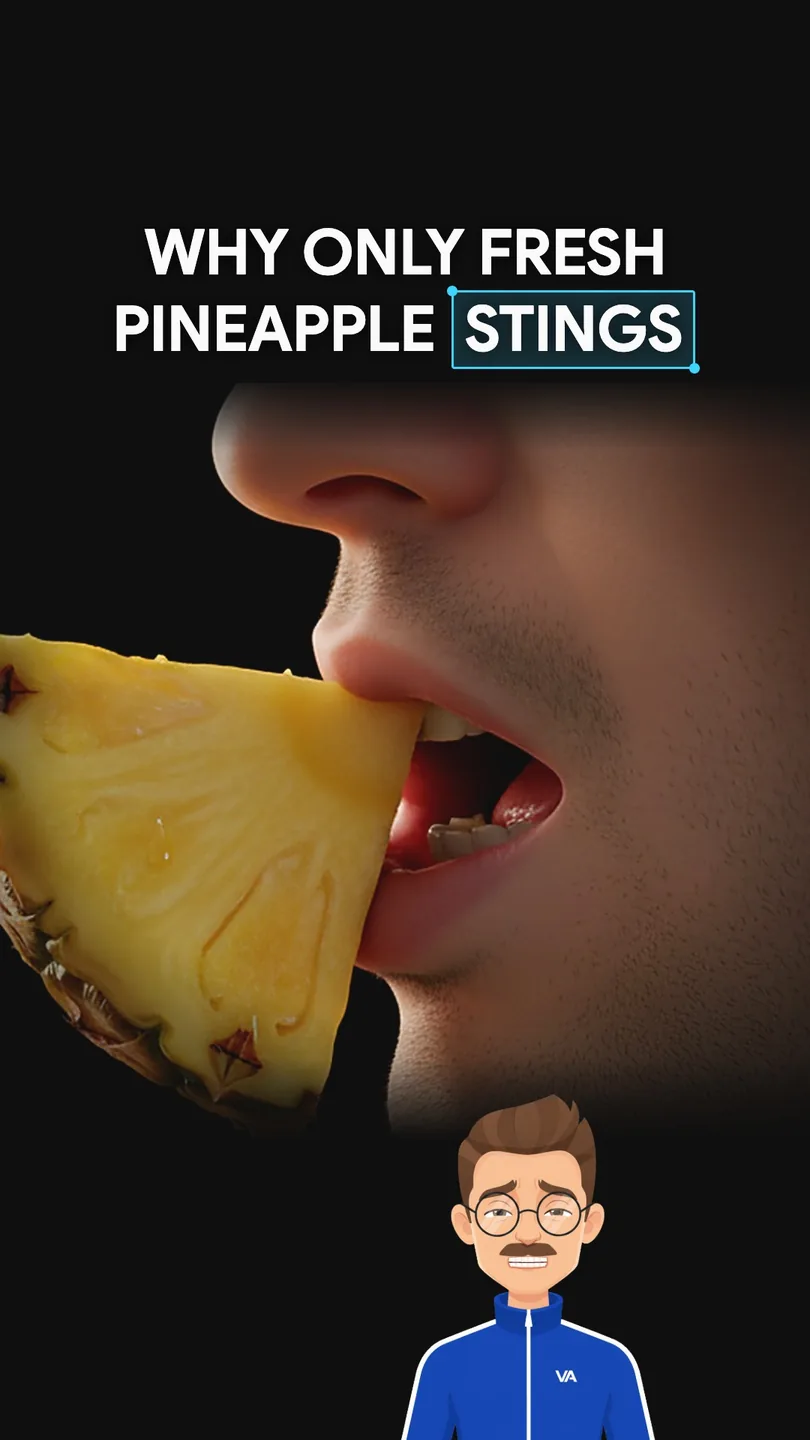
A few bites into fresh pineapple, your tongue starts to sting and feel raw. Pineapple is full of an enzyme that breaks down protein. It's the same enzyme that's sold to soften raw steak. In your mouth, it breaks down some of the mucus that protects your tongue and cheeks. So the fruit's acid reaches the lining underneath, and it stings. But canned pineapple doesn't sting. It's still acidic, but the heat from canning destroys the enzyme.
- "A few bites into fresh pineapple…" Your body, a moment (time marker first) and what's wrong. "A few bites" follows the sources: the sting builds after several pieces.
- "Pineapple is full of an enzyme…" The cause, and the weakest picture: "enzyme" and "protein" show a listener nothing. The name, bromelain, stays on screen.
- "…sold to soften raw steak." It turns "breaks down protein" into an image people repeat to friends.
- "In your mouth, it breaks down some of the mucus…" Place marker first. "Some of" is the source's own scope.
- "So the fruit's acid reaches the lining underneath…" "So" keeps the chain, but the acid was never introduced. When I audited the batch, a simulated one-listen pass lost the thread here and nowhere else.
- "But canned pineapple doesn't sting." The one turn, and a picture: a can.
- "It's still acidic, but the heat from canning destroys the enzyme." It answers line 1's question (why only fresh?), and the contrast proves the enzyme matters. The script asked for a last shot back at the opening bite; the reel ends instead on fresh and canned side by side.
The CTA sits outside the story: this reel ran with "Follow for more." Part of its claim ledger:
| Claim | Source | Status | Use |
|---|---|---|---|
| An enzyme that breaks down protein | NIH NCCIH: Bromelain | verified | Voice; the name on screen |
| Sold to soften raw steak | US meat rules, 9 CFR 424.21 | verified | Voice |
| Breaks down some of the mouth's mucus | McGill Office for Science and Society | commonly cited | Voice, in the source's scope |
| Canned is still acidic | FDA, Approximate pH of Foods | verified | Voice; pH ranges on screen |
| Most people blame the acid | Monash University Malaysia, 2019 | supports "some" only | Cut |
The last row is why the reel opens on the sensation: an earlier version began "most people blame the acid", but the source only said some do. Under today's rules, I'd also introduce the acid before sentence 5.
A template you can copy
This skeleton is the order of work, not a fill-in-the-blanks script: I never reuse the previous reel's opening, sentence frame or ending.
## 1. Claim ledger (first)
| Claim | Source URL | Status | speakable / screen-only |

## 2. One idea
When [situation], [visible event] happens, because [one cause].
Told to a friend: the story in plain words, in order.
Struck: facts that aren't steps of the one idea.

## 3. Listen key (sealed now, never edited)
Gist · Chain: 4 to 7 events in order · Who was what, when

## 4. Hooks
8 to 10 first lines. Score: picture at frame 0 · what's wrong
by word ~9 · the question it raises. Keep the clearest.

## 5. Beat map
One row per sentence: when · where · link (so / but / then) · picture

## 6. Voiceover
One moment per sentence, marker first. One noun per thing.
End on the payoff.

## 7. CTA (after the payoff)
Share: Send this to [the specific person].
Follow: And follow for more.
Where AI fits
Claude Code writes my drafts. The procedure lives in a project skill (.claude/skills/write-script/SKILL.md) and the rules in the project's docs. For each topic, the skill:
- researches on the web and builds the ledger, never from memory, and stops if the payoff can't be verified;
- tells the story plainly, writes the one-idea sentence and strikes everything off it;
- seals the listen key, scores hooks and lays out the beat map;
- writes two drafts with different hooks or structures;
- lints and listen-tests them, rewriting only flagged sentences, and cuts an idea after three failed rounds;
- hands them to a fresh critic, revises the flagged lines and tests again;
- maps every claim in the final voiceover to a ledger row.
Two jobs stay outside the writing agent. The first is the facts: someone other than the writer has to check each line against its source; in my pipeline that's the fresh critic, working from the ledger. My own pipeline once wrote "most people blame the acid" when the source said "some". The second is the final read, and that one is mine: I read every voiceover in full and picture it line by line before I approve it.
Where to start
- Write your next topic's one-idea sentence. If it takes two, you have two reels.
- Build the ledger before you write a line.
- Write line 1 as a picture, tell the rest in order, and play it once to someone who hasn't read it.
The free Script Kit has my first rule set (the 18 laws) on one page, the first version of the checker and three annotated example scripts. The course teaches the whole workflow behind @valueanimate, from script to finished reel. For production, read how I make Instagram reels with Claude Code and how I animate them with Remotion.