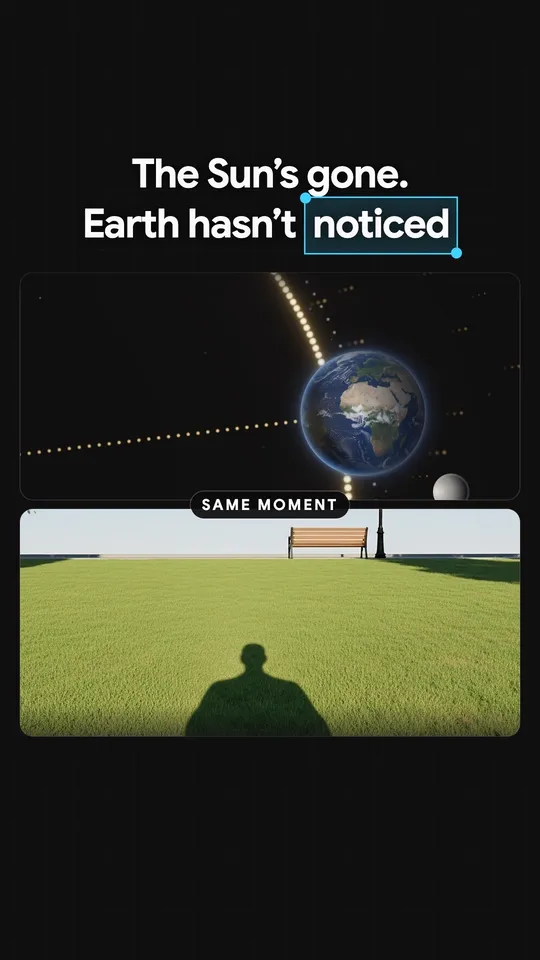
What if you dug a hole through the Earth and jumped in?
In an airless hole straight through the Earth, you'd fall about 38 minutes to the far side, stop at the edge, then fall back. Gravity speeds you up until the centre, so you shoot past it, then slows you as you rise. The 38 minutes is from a 2015 calculation, and with no air you'd swing back and forth forever.
What the reel shows
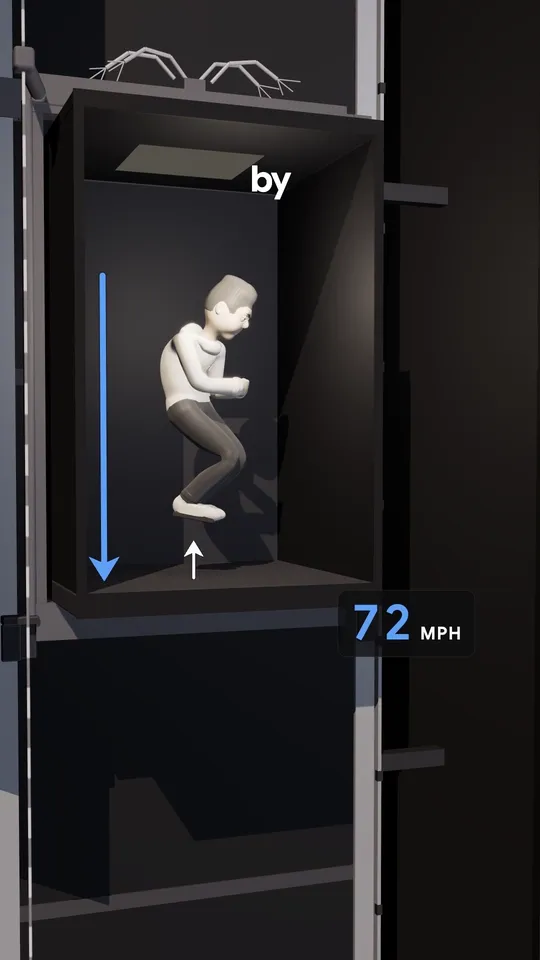
The reel opens looking down between your feet into a hole in a backyard. Then the planet is cut open, with the shaft running from pole to pole and the hot core marked. A clock and a speed bar run as you fall faster toward the centre, shoot past it and slow down on the way up. At 38:11 you reach the far end and stop for a moment. You fall back, and the last shot is the first: the edge of your own backyard.
Transcript
You step off the edge of a hole that goes straight through the Earth, right in your backyard. Pretend there's no air and no heat in this hole, so it's just you and gravity. Gravity pulls you toward the centre of the Earth, so the deeper you fall, the faster you go. You keep speeding up, all the way down to the very centre of the planet. You might think you'd get stuck here, but you're moving so fast that you shoot straight past the centre. Now the centre is behind you, so the same gravity starts slowing you down as you rise toward the other side. 38 minutes after you jumped, you reach the other end of the hole, on the opposite side of the planet. You've been slowing down the whole way up, so right at the edge, you stop, just for a moment. Then you fall back in, all the way through, and rise back up to the edge of your own backyard. And with no air to slow you down, you'll keep falling back and forth like this, forever.
The facts, with sources (7)
- The hole would be 12,742 km long. Straight through the centre, the shaft is one Earth diameter, twice the planet's mean radius of 6,371 km. NASA Earth Fact Sheet
- A model of the real Earth gives 38 minutes. With a model of the Earth's layers, a 2015 paper in the American Journal of Physics found a fall time of 38 minutes 11 seconds. The classic answer for an Earth of even density is 42 minutes 12 seconds. Klotz 2015 (arXiv) · Gravity train (Wikipedia)
- Gravity grows before it fades. In the real Earth, the pull rises to about 1.09 g at the core boundary, then falls roughly linearly to zero at the centre. Klotz 2015 (arXiv) · Fox News
- You pass the centre at top speed. The maximum speed comes at the middle of the trip. In an even-density Earth it is near 8 km/s, over thirty times a typical airliner, and the real Earth gives more. Klotz 2015 (arXiv) · Gravity train (Wikipedia)
- Then the same gravity slows you down. Past the centre, the pull points back toward it, so the motion is symmetric and your speed reaches zero right at the far surface. Klotz 2015 (arXiv) · Gravity train (Wikipedia)
- With no friction, it never stops. A frictionless gravity tunnel would oscillate back and forth forever. Air in the hole would slow every swing. Gravity train (Wikipedia)
- The real core is about as hot as the Sun's surface. The surface of Earth's inner core is estimated at about 5,430 °C, which is why the reel pretends the hole has no heat. Earth's inner core (Wikipedia)