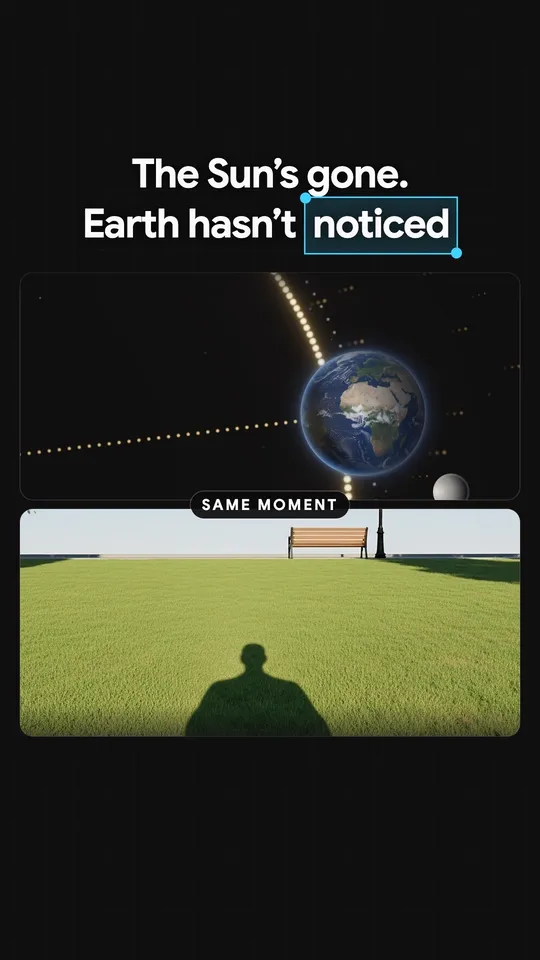
Can you outrun the sunset?
Yes, if you go west as fast as the ground under you turns east. At the equator that is about 1,000 miles an hour. Farther north the ground moves slower. About 12 miles from the North Pole it moves at walking pace, so in the Arctic summer a walk west keeps the Sun in place.
What the reel shows
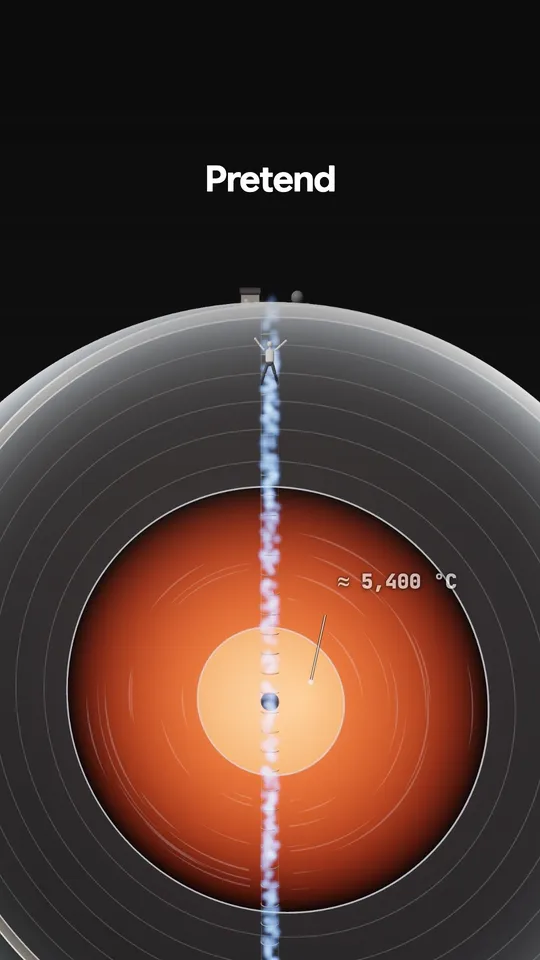
The reel opens on a runner sprinting west along a beach at sunset, then pulls back to the turning Earth. A counter gives the ground's speed at the equator, 1,037 mph, and a ring shows one turn a day carrying you all the way around the planet. Moving north, the ground slows to a passenger jet's speed in Anchorage, Alaska, and a race car's in Qaanaaq, Greenland. It ends with a walker circling near the North Pole, keeping up with the Sun.
Transcript
If you ran west at sunset, could you ever keep up with the Sun? Well, the Sun isn't really moving. The ground under your feet is turning east, and it's carrying you away from the Sun. So to keep up, you'd have to run west as fast as the ground moves east. At the equator, the ground moves at about a thousand miles an hour, so that's how fast you'd have to run. But the whole Earth turns just once a day. At the equator, that one turn carries you all the way around the planet. Farther north, the same turn carries you around a smaller circle, so the ground under your feet moves slower. In Alaska, the ground has slowed to the speed of a passenger jet. In the far north of Greenland, it's down to the speed of a race car. And about twelve miles from the North Pole, the ground only moves east at walking pace. So on the equator, you'd have to run at a thousand miles an hour, but up near the Pole, you wouldn't have to run at all. You could walk west, and keep up with the Sun.
The facts, with sources (7)
- Sunset comes from the Earth's turn. The Earth spins toward the east, which is why the Sun, Moon, planets and stars all rise in the east and set in the west. NASA StarChild
- Matching that turn holds the Sun in place. Moving against the Earth's rotation at its speed "would allow you to keep the sun at the same position in the sky", the Smithsonian says. Smithsonian, How Things Fly · EarthSky, 2009
- At the equator, the ground does about 1,037 mph. One lap of the Earth's 40,075 km equator in 24 hours is about 1,670 km/h, or 1,037 mph, by the reel's sum from NASA's figures. That is faster than sound, which travels about 761 mph at sea level. NASA Earth Fact Sheet · NASA Glenn Research Center
- Farther north, the ground slows down. The speed at any latitude is the equator's speed times the cosine of the latitude. At 45° N it is about 733 mph, and in Anchorage, Alaska, at 61° N, the reel's sum gives about 500 mph. BBC Sky at Night Magazine, 2024 · Wikipedia, Earth's rotation
- In Qaanaaq, Greenland, it's race car speed. At 77° N, one of the northernmost towns in the world, the same sum gives about 225 mph. The fastest a Formula 1 car has gone in a race is 231.49 mph. Wikipedia, Qaanaaq · Wikipedia, Formula One car
- About 12 miles from the Pole, it's walking pace. A lap a day at about 3 mph is a circle about 74 miles around, which lies about 12 miles from the North Pole. No source states the 12 miles itself: it is the reel's arithmetic from typical walking speeds of 2.5 to 3.7 mph. Wikipedia, Preferred walking speed
- The season decides whether the Sun is up. At the North Pole the Sun sets around the September equinox and stays below the horizon until around the March equinox. In summer it stays above the horizon around the clock. NSIDC