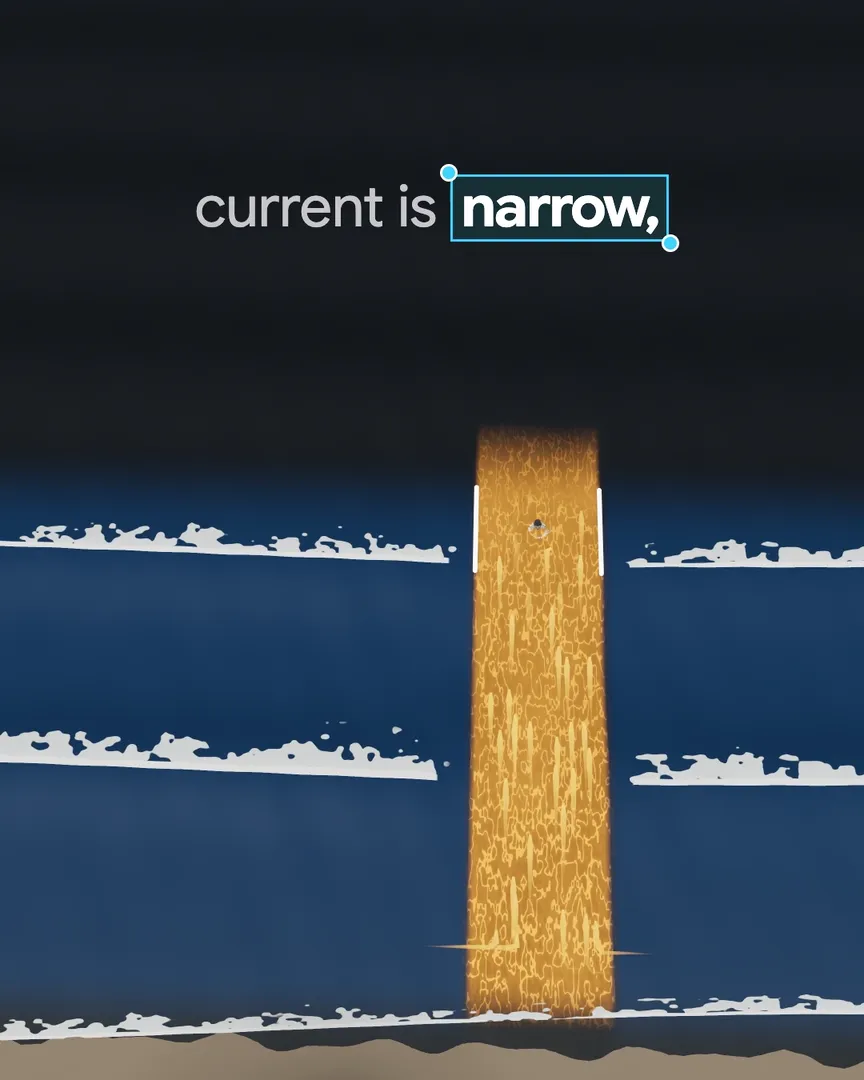
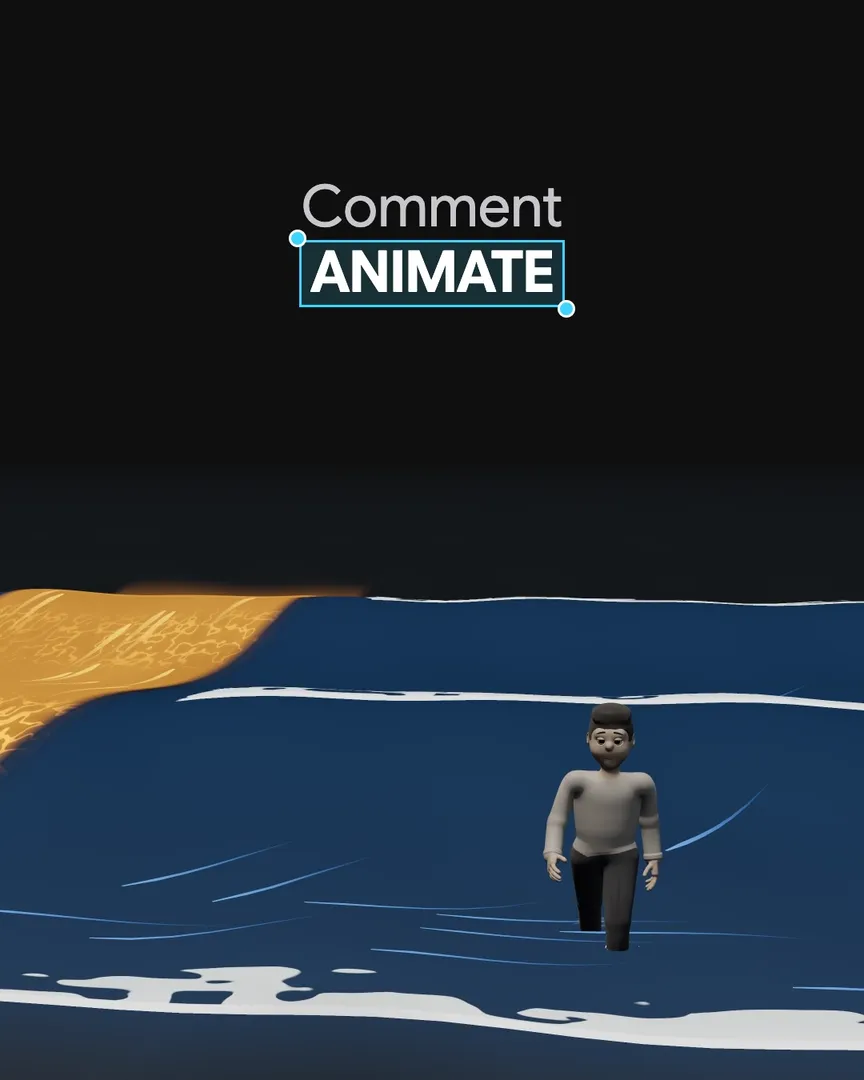
How to make videos like Zack D. Films: what's known, and my method
Zack D. Films hires contract 3D animators and prefers Blender; I found no source saying AI makes them. Here are 119 of his Shorts measured, and my method.
 By Gregor13 min read
On this page
Videos like Zack D. Films are short 3D animations that narrate one idea; his company has contract 3D animators make them, and prefers Blender. I found no source that says AI makes them. What this page adds: measurements from 119 of his Shorts, and my method for clay-3D explainer reels in his format, not his look, with Claude Code.
I'm not affiliated with Zack D. Films. I use the name only to describe a style, and every picture on this page is a frame from my own reels.
Who makes Zack D. Films videos?
A company does: Zack D Films LLC, which hires contract 3D animators to work with its producers. Its 3D generalist job ad describes the work as "20-45 second 3D clips" made with "our producers". A job call for contract animators says: "We assign 40 projects across our team per week." It is on the Quickdraw Animation Society's job board, with a zackdfilms.com contact address, and has been online since at least August 2025.
That also answers how the channel posts so fast: the animation is spread across a team, about 40 projects a week. In 2026 it put out about 4.7 Shorts a day, by my count from his catalog of 4,150 Shorts (analysis.md §0).
His YouTube channel had 29.9 million subscribers on 28 November 2026 and was ninth on YouTube's 2025 Top Creators list, ranked by subscribers gained in one country (The Hollywood Reporter).
What software does Zack D. Films use?
Blender is the only software his company names. Its job ad says "Blender proficiency is a major plus" and asks applicants which 3D software they know best, so Blender is preferred, not required. The job call on Quickdraw asks only for "industry-standard 3D animation software".
One animator's portfolio page describes his own setup for the channel: "my workhorse is Blender". He adds Cascadeur for character animation, BlenderKit, After Effects and EmberGen, and renders with Blender Studio's Flamenco. He says he made over 100 of the shorts "using royalty free content, custom modeling and character animation, some clever compositing, and some physics simulation". That is one artist's pipeline, not proof of what every animator uses.
| Claim | Source | How strong |
|---|---|---|
| Blender is preferred | the company's own job ad, posted 2026-07-20 | his company's words |
| Blender, Cascadeur, BlenderKit, After Effects, EmberGen | one animator's portfolio, undated | one artist's own setup |
| Unreal, Maya, Cinema 4D, Character Creator, Mixamo | no source found | not confirmed |
Blender itself is free and open source.
Is Zack D. Films AI?
Not as far as I could find, but it isn't confirmed either way. Every first-party source I found describes people doing the work. The 3D generalist job ad asks for "character animation, camera work, lookdev, shader effects, and simulations" and pays "a flat rate per project".
- I found no article that reports his videos are AI-made, and no statement from him on AI either way.
- The voice: fan wikis say Zack narrates the Shorts himself. I found no first-party statement, so treat it as unconfirmed.
- "Zack D. Films AI" pages: most pages that rank for "zack d films ai" are AI tool sites, either auto-made video summaries or AI-video makers selling their own template. Neither shows his method.
How long does one video take?
Public sources give no total. The company's job call has been online since at least August 2025. It set animators "a goal of 8-days for delivery after assignment" for one 20–45 second clip, assigned projects every Wednesday and paid a "$1000 flat fee per project". The hiring test in the current job ad is meant to take "a couple of hours". If it takes "longer than one day", the ad says, the role may not be the right fit.
For comparison, my latest batch: ten reels in about 14 hours from start to finish, with about 52 hours of agent time, up to ten agents at once. Each reel took 224 to 410 agent minutes (docs/04-production/batch-04-report.md). Besides my computer, I pay for a Claude plan and Google Cloud, pay as you go, for the voice.
What makes Zack D. Films videos work?
In my data, the first sentence matters most. Pace and reading level are the same in his hits and his weaker videos; the openings differ. I transcribed 120 of his Shorts on my own computer with whisper.cpp and coded the 119 that have a voiceover (research/creators/zackdfilms/analysis.md). They are his top 70 by views, his 25 newest, and 25 low performers from the same years. I also measured the pictures of 10 Shorts, the music of 13, and the length and views of a random 300.
| What I measured | His Shorts | File |
|---|---|---|
| Script length | median 82 words, 31 seconds | analysis.md §2 |
| Pace | 2.76 words a second | analysis.md §2 |
| First sentence | median 17 words; ends at 6.2 s (median) | analysis.md §2 |
| Subject named in sentence 1 | 82% (97 of 119) | analysis.md §3.4 |
| Opens with "If" or "When" | 50% of the top 70, 4% of low performers | analysis.md §3.1 |
| Opens with a question | 10% of the top 70, 32% of low performers; within 2022–23 alone, about the same rate (6 of 15 vs 8 of 16) | analysis.md §3.1, §9 |
| A "But" turn | in 68% of scripts; the first lands at 10.3 s (median) | analysis.md §0, §4.1 |
| Follow or subscribe asks | 0 of 119 | analysis.md §6 |
| Hard cuts (one-frame jumps) | 0 to 6 a minute; 6 of 10 Shorts have none | pacing-benchmark-batch2.md §3 |
| A new view | about every 3 s (median gap 3.0–3.2 s) | pacing-benchmark-batch2.md §0 |
| Extra labels beyond the captions, at nouns | none in 8 of 10 Shorts (median 0%) | pacing-benchmark-batch2.md §3.1 |
| Music | library tracks matched in 8 of 13; 19 LU under the voice | music-analysis.md §1, §2 |
| Length and views | 35–50 s Shorts: 1.46× their year's median; up to 35 s: 0.93× | length-and-pacing.md §3.2 |
| Titles | exactly one emoji in 98.5% of 4,150 | analysis.md §8 |
What I read from it:
- The opening is a scene you're in. His most-viewed Short, How Stitches Work, had 255 million views when I catalogued it. It opens: "When you get stitches, a doctor threads a needle through your wound and pulls it tight to close the skin." In 2026 he opens more often with a story or process already in motion.
- The camera travels through one 3D world instead of cutting. The picture changes every few seconds, through push-ins, cross-sections and the process itself.
- The story stops on the payoff. No outro, no "follow for more", no poll. Polls and "part two" appear only in his weaker videos.
- The music comes from stock libraries. I checked library tracks named on a fan wiki against the audio of 13 Shorts, and they matched the music in 8. Seven of the eight are on Epidemic Sound or AudioJungle: plucked strings and mallets, around 105 BPM, from the first frame to the last word.
- Longer isn't worse. My 119-Short study shows no length gap between hits and weaker videos, but its most-viewed list is mostly 30-second Shorts from 2024. In a random sample of 300, his 35–50 second Shorts beat his 20–35 second ones in every year from 2022 to 2026, though with only four a year before 2025. His share of Shorts over 35 seconds grew from 7% in 2024 to 42% in 2026.
- Topic matters less than execution. Across 15 topic groups, the typical video does within 0.92× to 1.27× of its neighbours. The biggest outliers cluster in two kinds: body mechanisms and hidden reasons behind familiar objects make up 49 of his 104 Shorts with 70 million views or more.
What went wrong when I copied his numbers
My first scripts copied the surface of his hits, and they failed by ear. I turned his typical numbers into rules, such as an 80-word budget and one "But", though neither separates his hits from his flops. The scripts read well on paper. On the first listen, I didn't understand my own first three posted reels. They also packed two to five ideas into each reel, where his have one (docs/02-copywriting/README.md).
So I rebuilt my script rules around one test: someone who hears it once can picture every sentence and retell it. His transcripts now calibrate my script checker: a rule that fails more of his hits than his flops is a bad rule. I run this after every rule change:
tools/.venv/bin/python tools/scripts/lint_script.py --calibrate zackdfilms --hard --tuneCalibration on 144 real zackdfilms transcripts (no budget check, no copy check)
would FAIL: 41/144 (28%)
15 HARD:sentence-too-long
12 HARD:creator-voice
8 HARD:hedge-filler
… 11 more rules, 3 or fewer scripts each
…
Tuning (hits = the 72 most-viewed, flops = the 72 least-viewed):
sentence-too-long 15/144 · hits 6/72 · flops 9/72 → more on flops: keep
13 more rules fail under 15 scripts each: too few to judgeThat run is from 28 November 2026, on the 144 transcripts I now hold: the 120 from the study plus 24 added on 13 November. The lines marked … are cut. The biggest failure, a very long sentence, hits more of his flops than his hits, so the rule stays; whisper merges some of his sentences, which can inflate that count. The second is the narrator talking as himself. In my earlier study, a narrator talking as himself appears in 6% of his top 70 against 32% of the low performers (analysis.md §9).
How to make videos in this style: my method
I animated @valueanimate by hand in After Effects in 2024, and that wasn't sustainable. Now Claude Code does the production, following two written skills, and I approve every script and watch every reel. The method shares his format: short, narrated, one idea, 3D. It doesn't share his look.
- Pick one idea with a scene in it: your body in a moment, an object in your hand, a person in a strange situation. If you can't say it in one sentence, you have two reels.
- Collect the facts before you write. Every claim goes into a claim ledger with its source link. Some AI-video tutorials tell you to rewrite his transcripts. Don't: write from your own sources.
- Write it for the ear. Line 1 is a picture, each sentence holds one moment, time only moves forward, and the length follows the story, from 20 seconds to 2:50. The free Script Kit has my rules on one page, a lite version of my write-script skill and the checker. My guide to writing an explainer reel script goes through it line by line.
- Test it before anything is drawn. The checker, then a first-listen test where 10 simulated listeners hear the script one sentence at a time and retell it, then a fresh critic. Then I read it.
- Voice it. Gemini's Charon voice, plain, sped up 5% and mastered to −14 LUFS. It speaks about 3.5 words a second, measured on 28 delivered reels, faster than his 2.76. One batch tried the same voice slower, in a storyteller style; it sounded too dramatic, and I went back to the faster, plain read by ear.
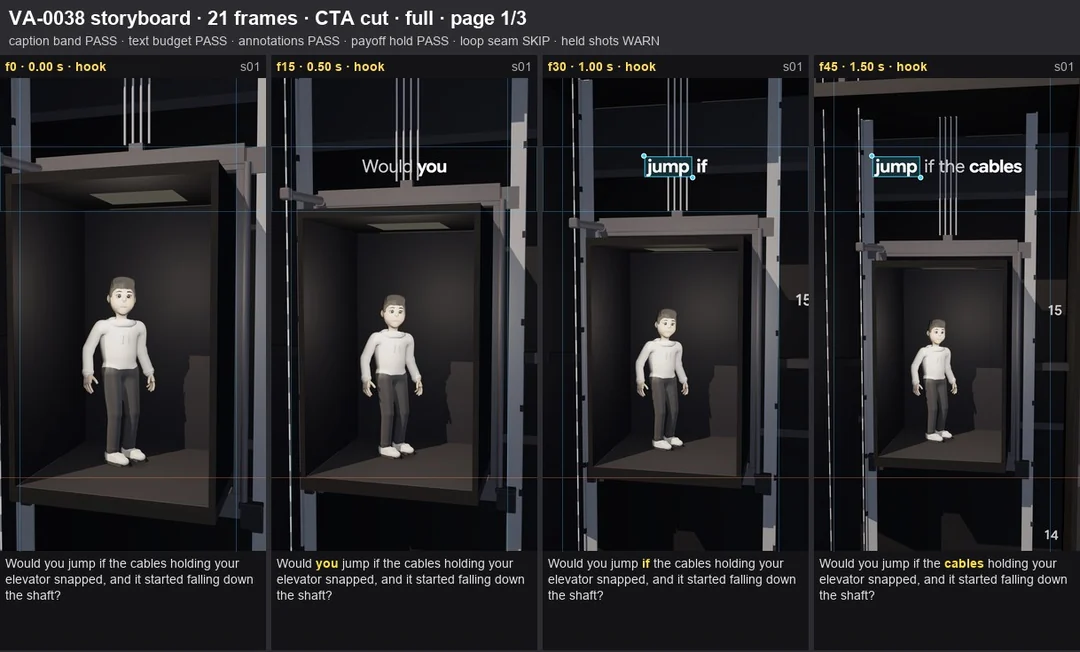
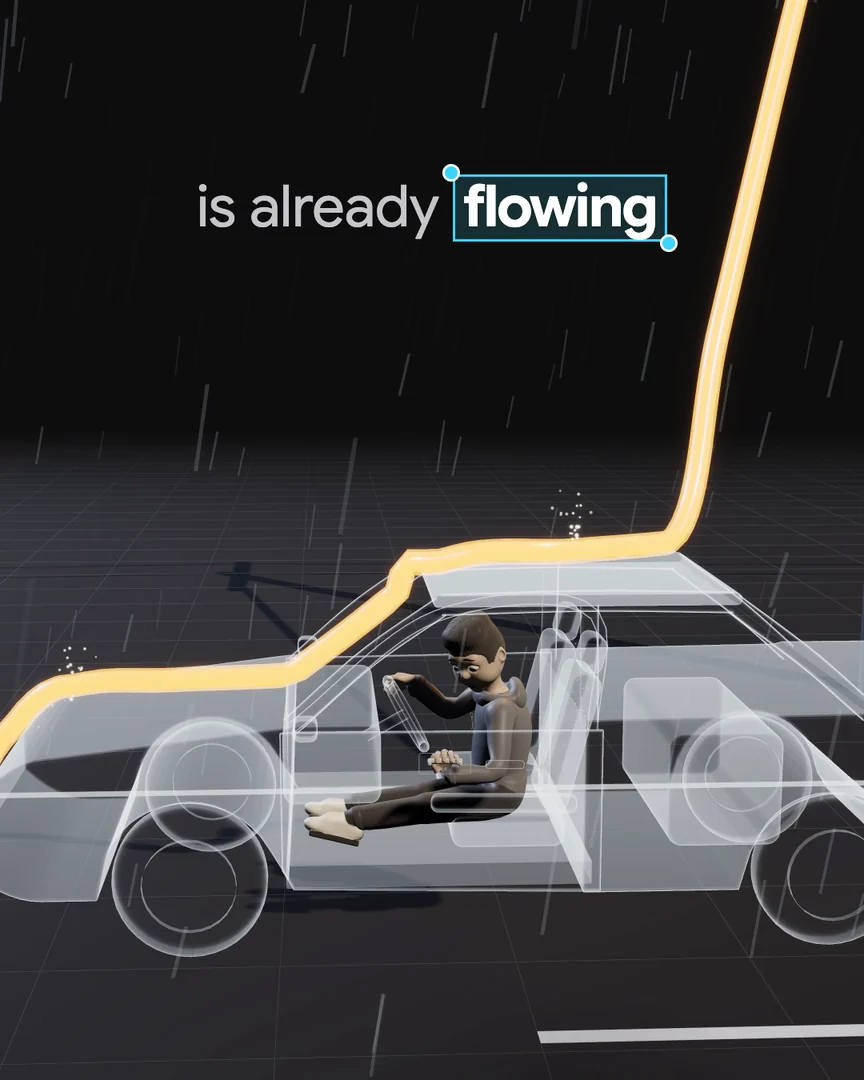
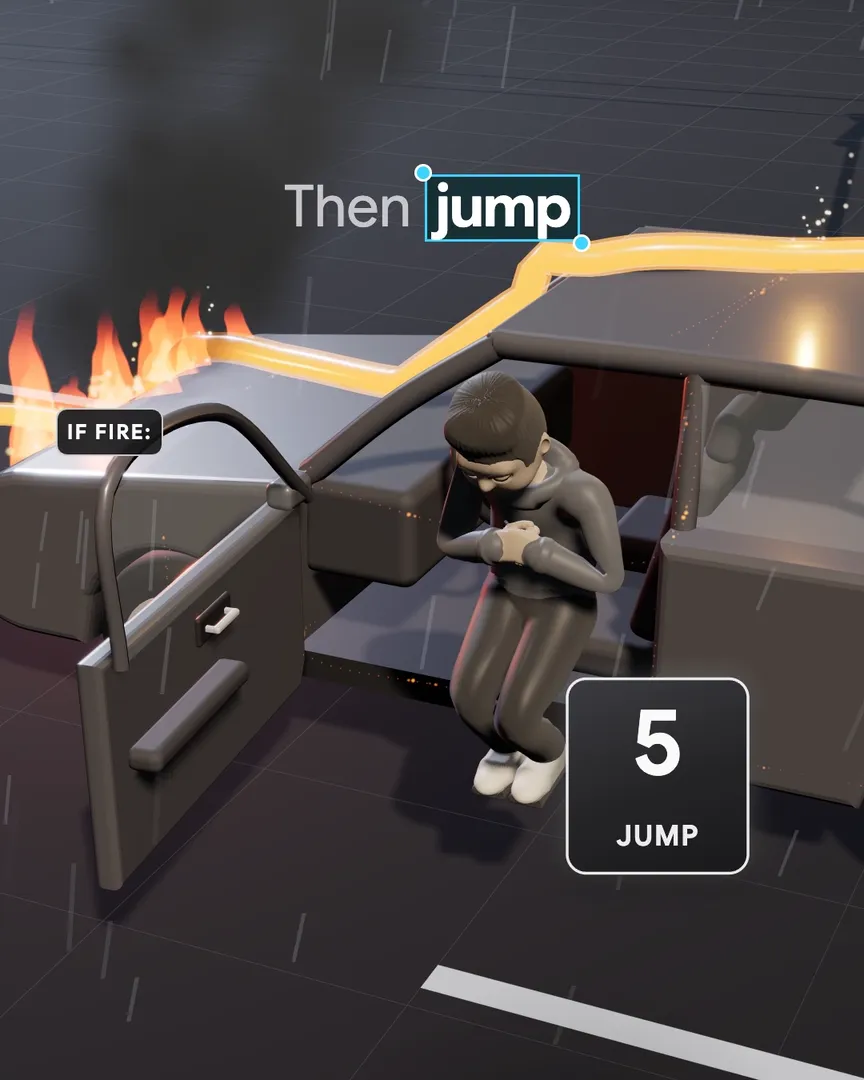
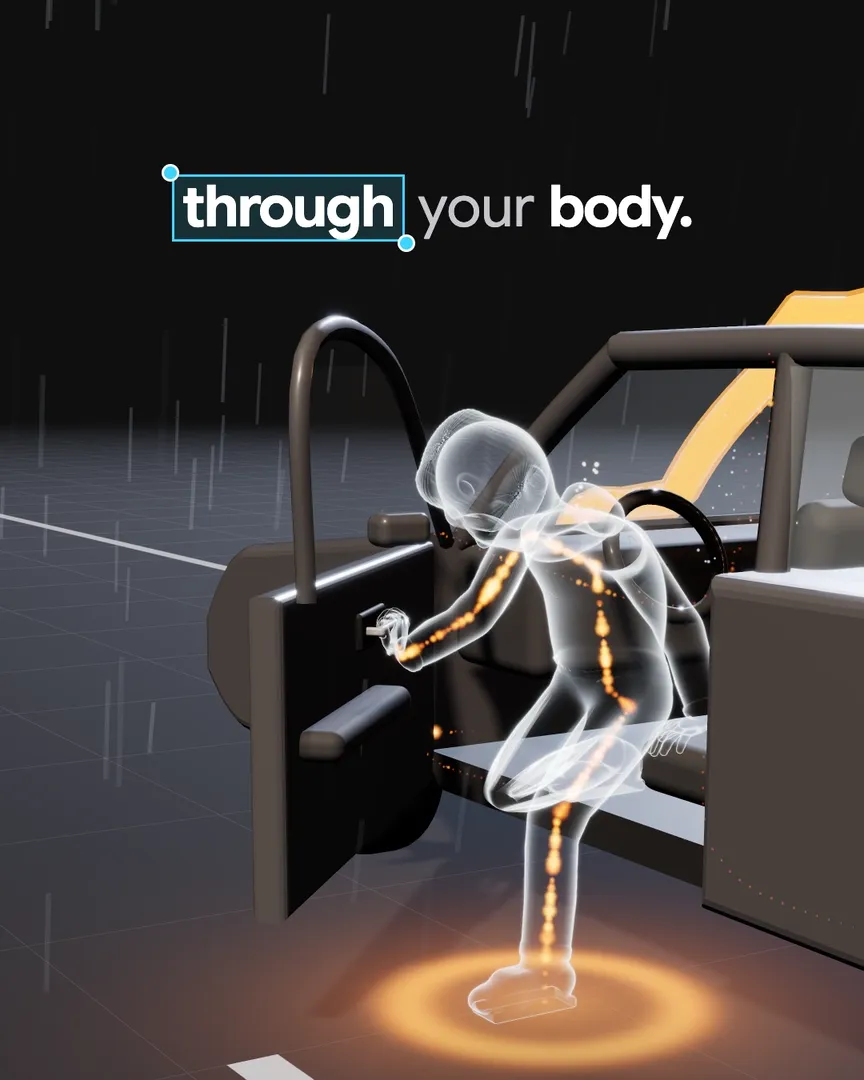
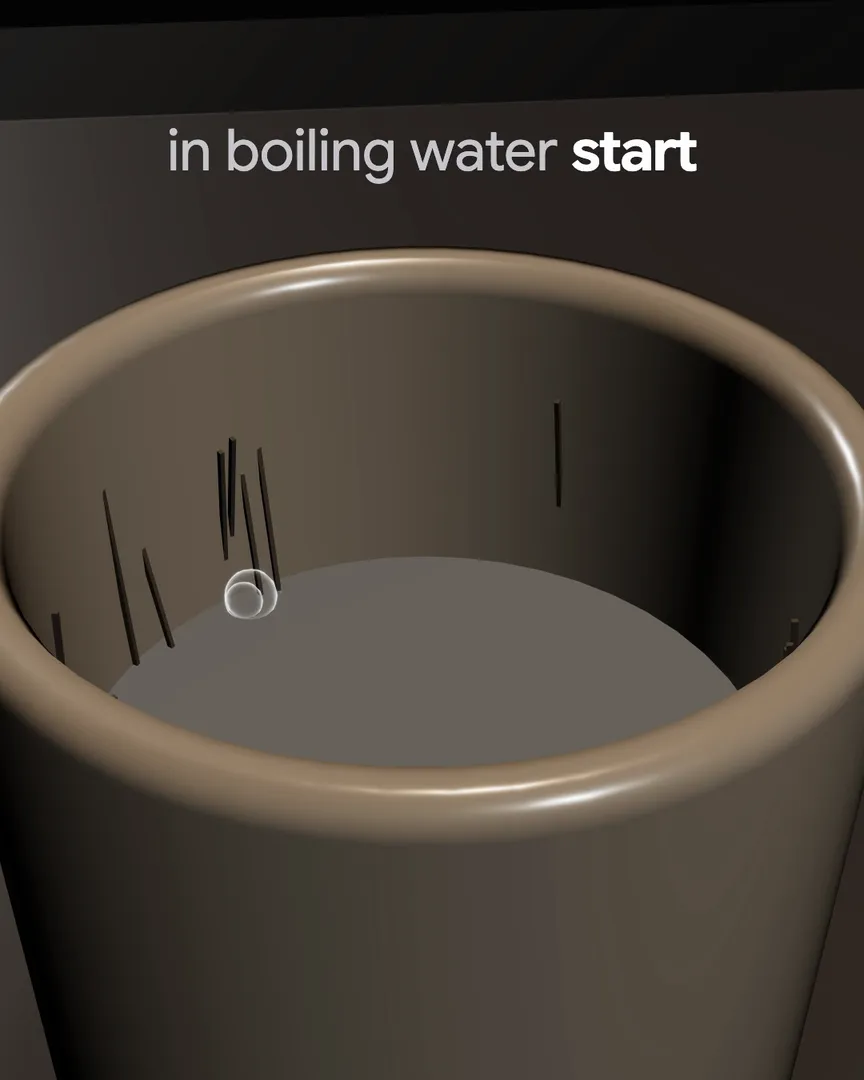
- Build one world and many cameras. Each reel is one 3D clay world, built in code with Remotion and three.js, and every shot is a camera on it. Gold marks the one invisible thing the reel explains. People are my own clay characters, and the sound is real recorded effects with no music.
- Storyboard, preview, render, check. A fresh critic reviews a sheet of stills before any motion is built, and a second one reviews a half-size preview. Then one final render runs automatic checks on format, loudness, sync, motion, caption contrast, sound and things passing through each other.
The first-listen test is one command. This is the run for VA-0039, while its script was still a draft:
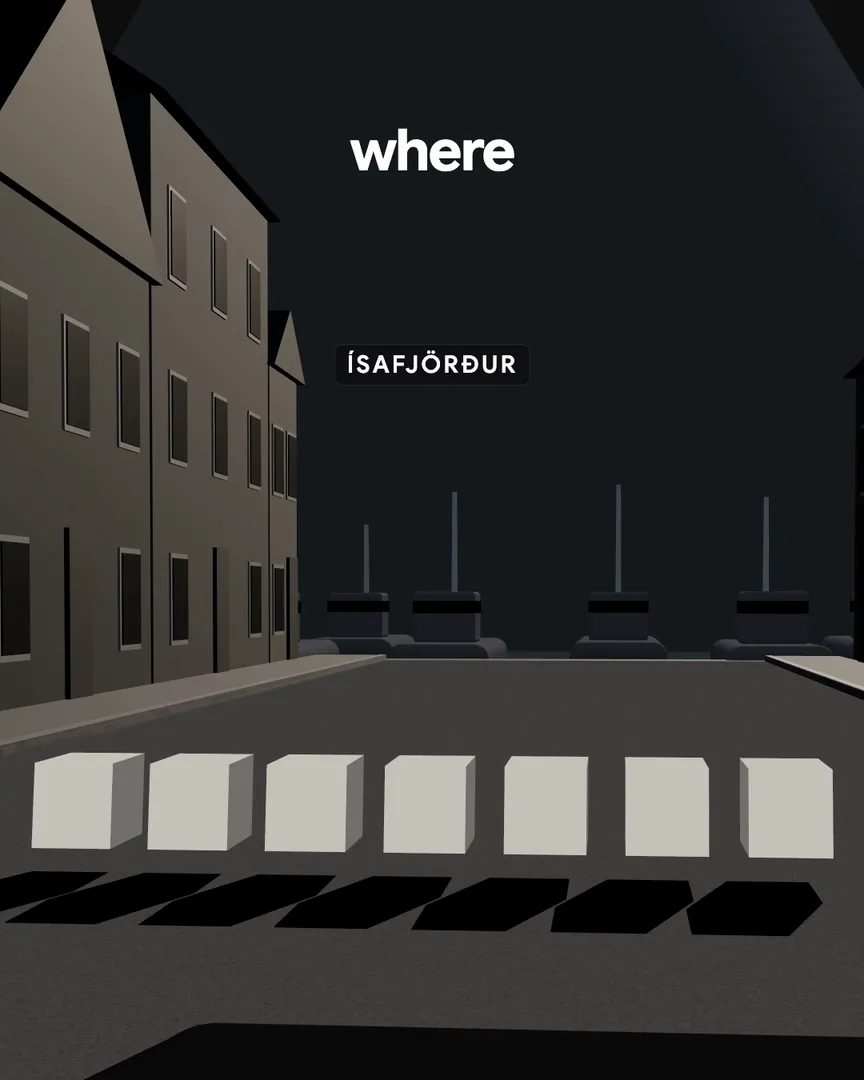
tools/.venv/bin/python tools/scripts/listen_test.py content/scripts/drafts/VA-0039_the-crosswalk-that-floats-above-the-road.md --samples 2 --out content/scripts/listen/VA-0039_r1.mdThat script became my reel on Iceland's 3D crosswalk. Two quick tests on earlier drafts failed first, with 3 of 5 listeners getting the gist each time (content/scripts/listen/VA-0039_A.md, VA-0039_B.md). The gate round above then passed: all 10 listeners followed every sentence, and 9 of 10 retold the gist correctly (content/scripts/listen/VA-0039_r1.md).
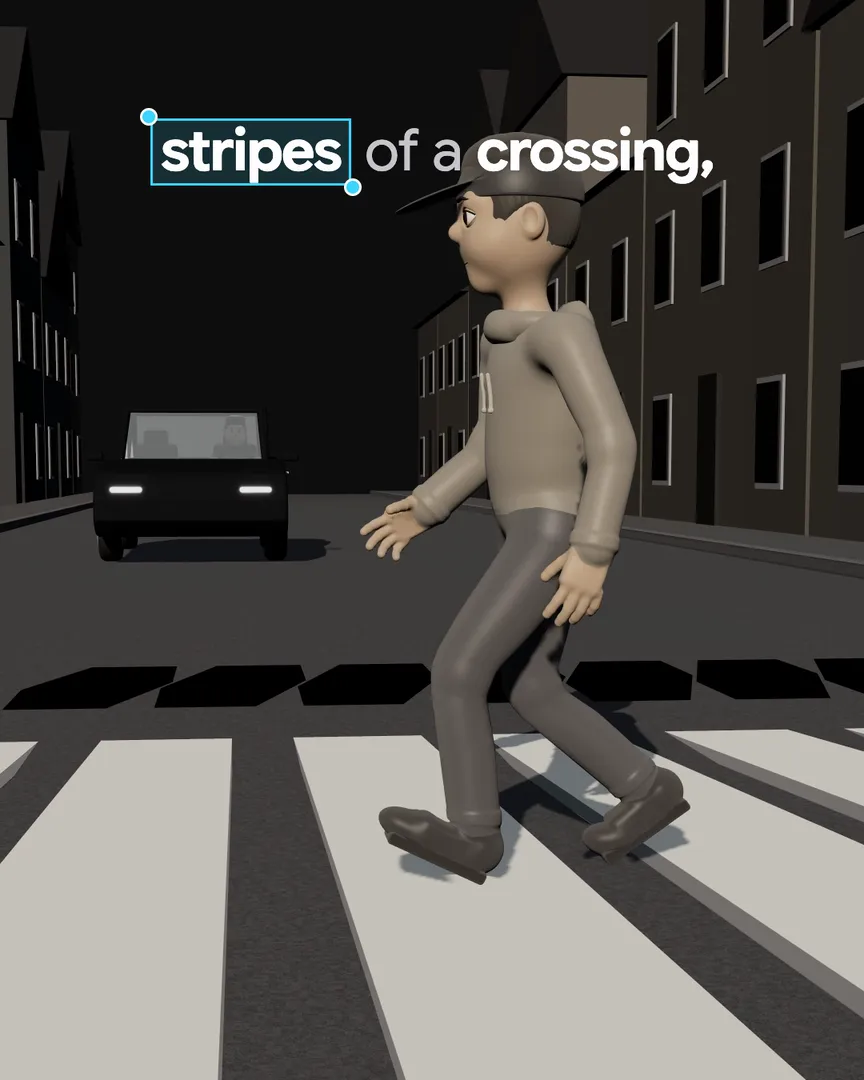
That reel also shows step 6. It's one street in one clay town. The first camera sits in the driver's seat, where the crossing seems to float:
Fourteen seconds later, a camera at the crossing shows the same stripes are flat paint:
In my microwave reel, the world is one mug, and a camera goes inside it to show where bubbles start:
The gates catch a lot. In my latest batch, every storyboard went back at least once (build-log.md §4.35), and six of ten reels needed a second round of fixes (docs/04-production/batch-04-report.md). The full pipeline, with the code, is in my guide to making videos with Claude Code and Remotion. Remotion's own page on prompting videos with coding agents is a good first step.
Where my reels differ from his
| Zack D. Films | My reels | |
|---|---|---|
| Who makes them | a company: producers and contract 3D animators, per its job ads | Claude Code agents; I approve each script and watch each reel |
| Look | bright and colourful: brightness about 0.5, about 4–11% near-black pixels (group medians) | dark: graphite clay, glass and gold light on near-black |
| Labels beyond the captions | almost none: none at the sampled nouns in 8 of 10 Shorts | at most three labels a reel, only numbers or names |
| Music | stock library tracks under the voice | none: the voice and real recorded sound effects |
| Voice | a narrator at 2.76 words a second | an AI voice at about 3.5 words a second |
| Length | median 31 seconds | 20 seconds to 2:50, set by the story |
| Output | about 4.7 Shorts a day | batches of ten |
Sources: his column from his job ads, analysis.md, pacing-benchmark-batch2.md and music-analysis.md; mine from my look file (.claude/skills/make-video/references/look.md) and the script rules (docs/02-copywriting/README.md). I tried music matched to his, measured against his tracks, and rejected all three versions in favour of sound effects only (docs/00-project/decisions.md).
If you want his bright, character-driven look, do what his company does: hire 3D artists; its job ad prefers Blender. My way suits one person who wants a different look and lets Claude Code do the production.
His look is his: his characters, his scenes and his scripts. I don't copy them, and you shouldn't either. The format is open to anyone: one idea, a scene, a turn, a payoff, then stop. With 4,150 Shorts, his catalog touches many curiosity topics, and several of mine overlap with his, such as a power line on a car. My topics come from my own topic research, which checks every working title against about 11,000 Shorts from many creators so that none is copied. The facts, the script and the world are made from scratch for each reel.
What isn't publicly confirmed
- Software beyond Blender: the only list I found is one animator's. I found nothing that names Unreal, Maya, Cinema 4D, Character Creator or Mixamo.
- AI: whether any AI is used anywhere in his pipeline, and whether he narrates himself.
- Team size: figures from "over 50 people" to "almost 300 employees" circulate, from a third-party video and a fan wiki, with no checkable source.
- Cost per video: "$3,000 per video" circulates without a source. The only first-party figure is the animator's $1,000 flat fee per project in the Quickdraw job call.
- Who he is: his full name, age and city appear on fan wikis without a source I could verify, so I leave them out.
Where to start
Start with one script and test it by ear: no render saves a story that's hard to follow. My guide to making Instagram Reels with Claude Code covers the whole workflow, from topic research to posting.
If you want to make your own reels this way, AI Animation Mastery is one PDF you hand to Claude Code. It sets up a starter studio on your computer, designs a look for your niche with you, and makes reels with you. It costs $27 and needs a computer, internet and a paid Claude plan with Claude Code. It won't give you his look, and it doesn't try to.
How this page was made: I wrote it with Claude from my project's research files, production reports and build log, and from public sources checked on 28 November 2026. Every project number comes from those files, and every still is a frame from my own renders.
Not affiliated: Zack D. Films has no connection to Value Animate and hasn't endorsed this page; the name only describes the style.
Read next
Can Claude Code make videos? How I make mine with Remotion
Yes, Claude Code can make videos: it writes Remotion code that renders them. How I've made 40 reels with it: commands, render times, costs and what breaks.
20 min read
How to write a script for reels that people follow on one listen
Cut a reel script to one idea, source 8 to 15 facts, open on a picture and test it by ear. My template, and a script that failed six listen tests first.
18 min read
Claude Code for Instagram Reels and YouTube Shorts: my workflow
Claude Code writes, voices and animates my reels in code, about 5 hours of agent time each; I approve and post. The commands, checks, costs and failures.
16 min read